



Though menopause and menopause hormone therapy are well understood in some parts of the world, they still receive little attention or remain controversial in others. This is the reason why the IMS chose it as the official theme of this year's World Menopause Day. Their goal is to ensure that they empower the individual with evidence-based resources to make fully informed choices.
The October print issue of Climacteric includes Menopause and MHT in 2024: addressing the key controversies – an International Menopause Society White Paper: IMS White Paper 2024 Menopause and MHT in 2024: addressing the key controversies2.12 MB.
The paper is also available via Climacteric online with free access here.
From the paper:
Introduction
The aim of this 2024 White Paper is to provide an International Menopause Society (IMS) position statement about menopause and menopause hormone therapy (MHT), and in particular to address some of the key controversies. The paper’s purpose is to act as a blueprint upon which to base the future ethical management of menopause from both practical and aspirational perspectives.
The mission of the IMS is to work globally to promote and support access to best-practice health care for women through their menopause transition and post-reproductive years, enabling them to achieve this with optimal health and well-being. Through effective communication and evidencebased education about menopause, women can be empowered to make informed personalized choices aligned with their individual goals.
After many years of neglect, we have finally seen long overdue unprecedented attention given to menopause in the popular media, empowering women to seek care for menopause symptoms. Yet the media and even academic literature present polarized views on its management. These contrasting views often leave women feeling confused and disempowered rather than supported through their menopause transition and susceptible to unproven marketed products.
Very few therapeutic medical interventions have generated as much controversy, and very few have waxed and waned in popularity as much as MHT. Opinions about MHT appear to be driven as much by the sociocultural climate as they are by the emerging evidence from clinical trials. These sociocultural factors include demographics, education, reliogion, beliefs, values, social classes, sexuality and attitudes. The search for a well-balanced narrative of the menopause momentum continues [1]. This paper serves to lay the groundwork for this well-balanced narrative by defining the history and current context of menopause and MHT.
The aim of this White Paper is not to provide a comprehensive toolkit of therapeutic options and evidence for efficacy and safety; this is well covered by recommendations, guidelines and consensus statements. The paper is primarily intended to explore the following:
The key sections focus on questions commonly raised in clinical care and include the following:
Read full paper here
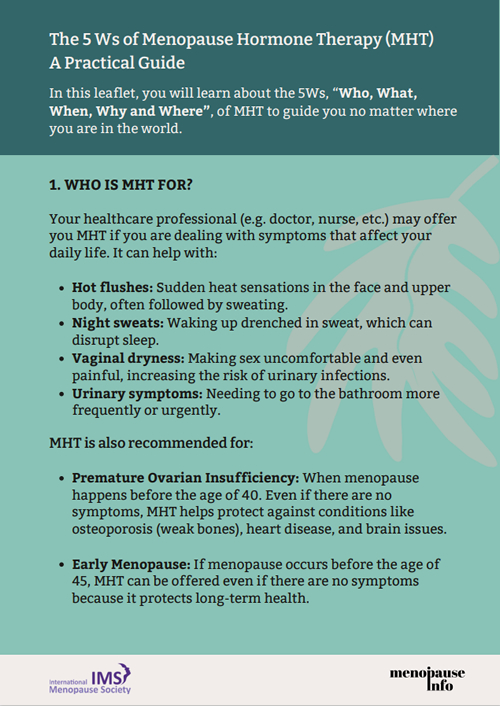
IMS has produced the Leaflet to help women to better understand about MHT.
You can download and read the Patient Information Leaflet here.
The 5 Ws of Menopause Hormone Therapy (MHT) A Practical Guide 2.07 MB
Content created October 2024

The Australasian Menopause Society (AMS) is a professional community dedicated to supporting health professionals who care for women through midlife, menopause, and beyond. Together, we share knowledge, resources, and connections to advance evidence-based practice and improve women’s health.
[email protected]
+61 3 7076 1930
Australasian Menopause Society Limited
PO Box 4009
Hopetoun Gardens VIC 3162
Australia
ABN 69 867 357 105

