



World Menopause Day is held every year on the 18th October. The purpose of the day is to raise awareness of the menopause and the support options available for improving health and wellbeing. We encourage professionals and women to participate in this global awareness raising campaign by printing and sharing these materials, organising events to engage their communities, and sharing World Menopause Day social media posts.
The October print issue of Climacteric includes Brain fog in menopause: a health-care professional’s guide for decision-making and counseling on cognition:
IMS White Paper 2022 Brain fog in menopause1.26 MB.
The paper is also available via Climacteric online with free access here.
From the paper:
Introduction
Cognitive complaints are frequent in midlife women and are associated with decreased quality of life [1]. These cognitive complaints are reliably validated and documented across the menopause transition (MT). Basic and clinical studies show a role for estradiol (E2) in mediating menopause-related changes in cognition [2]. In addition, menopause symptoms, including vasomotor symptoms (VMS), sleep disturbances and mood changes contribute to cognitive difficulties at midlife [3], but there are critical gaps in the data as to whether this period of cognitive dysfunction predicts dementia risk, and whether menopausal hormone therapy (MHT) is protective against late-onset dementia or increases the risk. The theme for the 2022 World Menopause Day is Cognition and Mood, and the goal of this International Menopause Society-commissioned White Paper on cognition is to provide menopause practitioners with an overview of data informing clinical care of menopausal women and a framework for clinical counseling and decision-making for their patients.
The key sections focus on questions commonly raised in clinical care and include the following:
Read full paper here
IMS has produced the Patient Information Leaflet to help women to better understand about cognition and mood.
What is Menopausal Brain Fog?
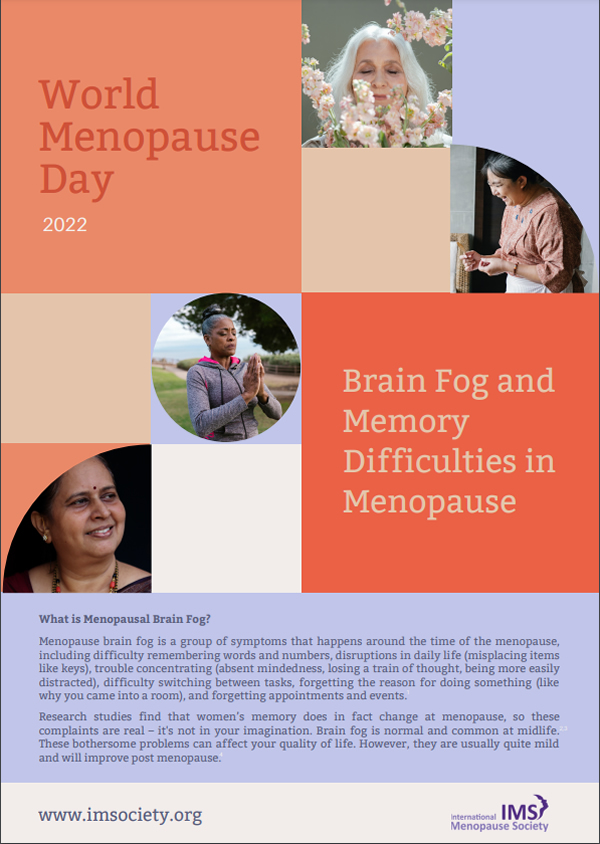
Menopause brain fog is a group of symptoms that happens around the time of the menopause, including difficulty remembering words and numbers, disruptions in daily life (misplacing items like keys), trouble concentrating (absent mindedness, losing a train of thought, being more easily distracted), difficulty switching between tasks, forgetting the reason for doing something (like why you came into a room), and forgetting appointments and events. Research studies find that women’s memory does in fact change at menopause, so these complaints are real – it's not in your imagination. Brain fog is normal and common at midlife. These bothersome problems can affect your quality of life. However, they are usually quite mild and will improve post menopause.
You can download and read the Patient Information Leaflet here:
Brain Fog and Memory Difficulties in Menopause 3.83 MB
Content created October 2022

The Australasian Menopause Society (AMS) is a professional community dedicated to supporting health professionals who care for women through midlife, menopause, and beyond. Together, we share knowledge, resources, and connections to advance evidence-based practice and improve women’s health.
[email protected]
+61 3 7076 1930
Australasian Menopause Society Limited
PO Box 4009
Hopetoun Gardens VIC 3162
Australia
ABN 69 867 357 105

