


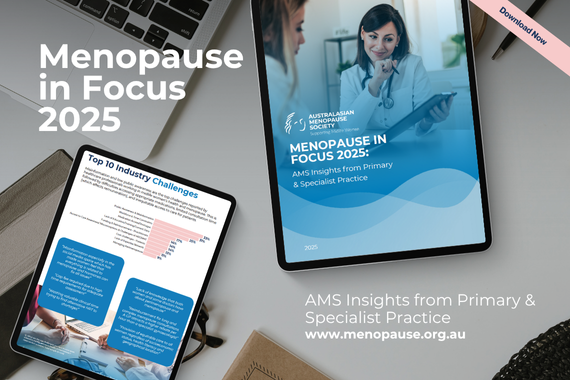
The Australasian Menopause Society’s report, Menopause in Focus 2025: Insights from Primary & Specialist Practice, is now available. Drawing on feedback from 246 healthcare professionals across Australia and New Zealand, the report provides an in-depth look at the current challenges, priorities, and support required to strengthen evidence-based menopause care.
The research provides valuable insight into what clinicians are experiencing on the frontline of midlife women's health.
Three clear themes emerged:
Following these findings and recognising the urgent need for accessible, reliable information, AMS has launched user-friendly AMS Content Hub to make evidence-based resources easy to find and apply in practice. This hub consolidates our clinical guidelines, patient education materials, recordings of past events and latest research summaries in one centralised location.
As we move into 2026, AMS remains committed to supporting clinicians and improving the health outcomes of women transitioning through midlife.

The Australasian Menopause Society (AMS) is a professional community dedicated to supporting health professionals who care for women through midlife, menopause, and beyond. Together, we share knowledge, resources, and connections to advance evidence-based practice and improve women’s health.
[email protected]
+61 3 7076 1930
Australasian Menopause Society Limited
PO Box 4009
Hopetoun Gardens VIC 3162
Australia
ABN 69 867 357 105

